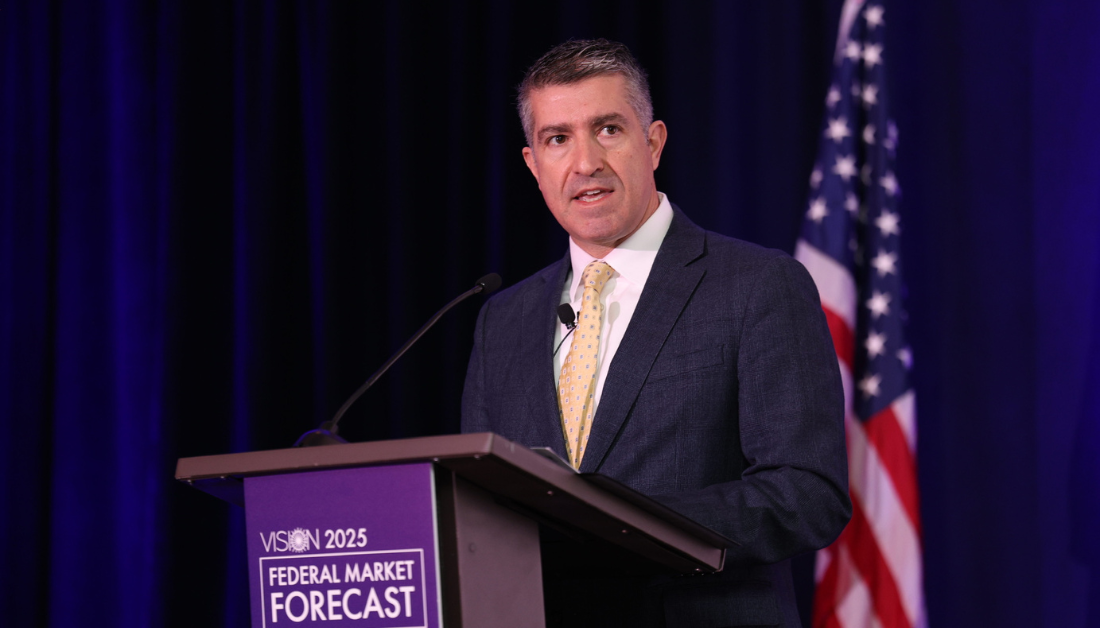
With the theme of collaboration, the Honorable Michael Cadenazzi, Assistant Secretary of War for Industrial Base Policy, underscored the importance of industry partnership, noting that with a base budget over $850 billion, “the Department of War will almost certainly spend more than $180 billion on services.” He also outlined his office’s mandate to revitalize the American industrial base that supports vital national security missions by investing in critical supply chains and workforce, protecting economic security, and accelerating small-business innovation.
Secretary Cadenazzi emphasized the evolving global security environment, warning that China’s “unprecedented 30-year industrial expansion program” and adversarial investment strategies threaten U.S. technological advantage. Describing the Department’s shift to a wartime acquisition posture, he said, “We’re increasing acquisition risk today to decisively decrease operational risk tomorrow.”
He also urged companies to help redefine "services” offered to the Pentagon and other departments and asked how industry can help the government “pioneer new pathways” that leverage artificial intelligence, modernize pricing models, and move beyond outdated contracting approaches. Expressing confidence that innovation and collaboration will strengthen warfighter capabilities, Secretary Cadenazzi stated, “If we lean into this and work together, we can reshape how services are delivered.”
2025 Macro-economic and Topline Defense Presentation
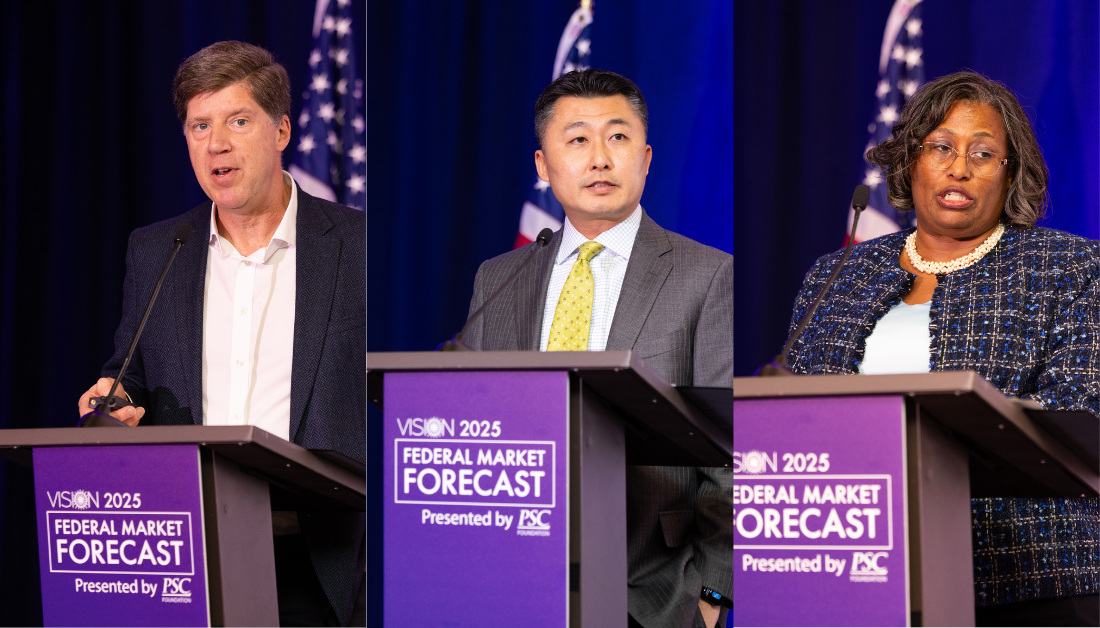
The Macro-economic and Topline Defense session outlined the volatile economic, political, and geopolitical forces shaping the federal and defense budget outlook. PSC Vision volunteers highlighted the difficulty of forecasting without a full-year appropriations in place for fiscal year 2026 (FY26) and pointed to pressures from tariffs, global economic slowdowns, and rising national debt. The presenters stressed that the federal budget remains fundamentally shaped by growth in mandatory spending and interest on the national debt, as well as evolving political priorities. Based on these factors, the volunteers believed it likely that near-term planning horizons will be characterized by legislative gridlock—with a longer-term scenario wherein mounting fiscal imbalances would eventually force tough decisions.
2025 Federal IT Management and Budget Presentation
The Federal IT Management and Budget session focused on federal IT spending amid a disrupted data environment and highlighted trends in artificial intelligence, cloud modernization, and agency governance. PSC Vision volunteers identified more than $7 billion in direct IT reductions and $8.5 billion in additional “shadow IT” reductions (i.e., spending embedded in broader contracts outside traditional IT tracking). They noted opportunities for innovative, efficient, and proactive IT solutions across government agencies.
The Acquisition Trends session summarized how federal acquisition is undergoing significant transformation, with a focus on streamlining processes, prioritizing commercial and off-the-shelf solutions, and expanding the use of best-in-class contracts and GSA schedules. Agencies are experiencing staffing constraints while implementing recent executive orders, Revolutionary FAR Overhaul changes, and the Pentagon’s acquisition transformation. In addition, small business programs are shifting with more competition required for direct awards and a growing emphasis on veteran-owned businesses.
The Customer Experience (CX) session recognized that CX is integral to federal operations, evolving from standalone initiatives to core services delivery. Recent legislation, executive actions, and digital modernization are driving outcomes-focused CX improvements that integrate technology, acquisitions, and mission delivery. Agencies increasingly emphasize efficiency, data management, and AI-enabled services, with a shift toward citizen-centric experiences requiring cross-agency collaboration and clear performance metrics.
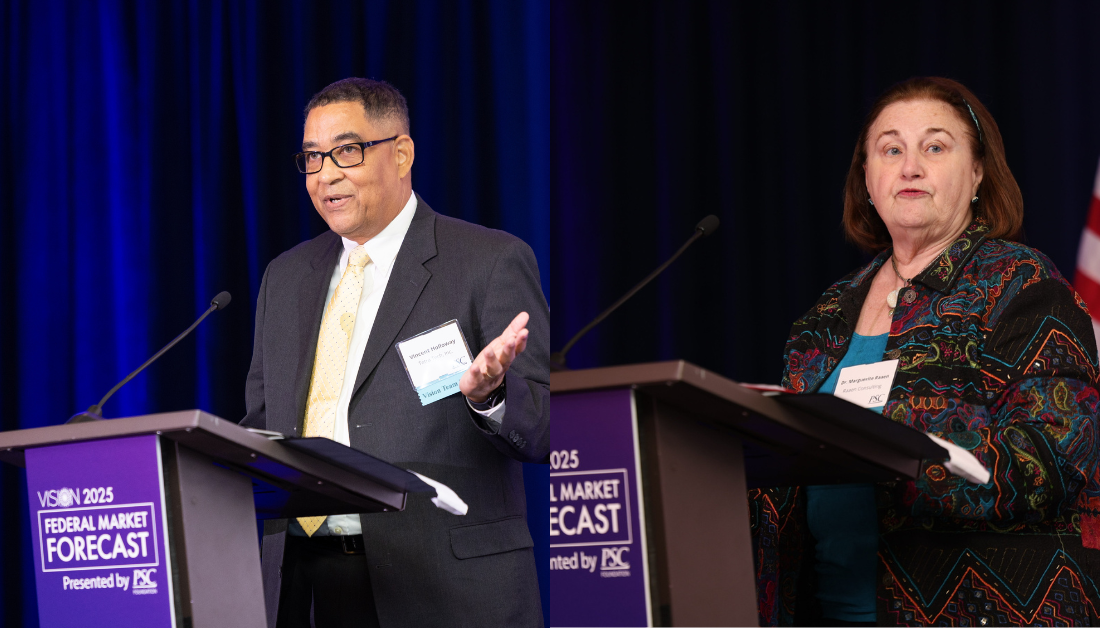
The Industry Outlook session described trends shaping the federal landscape, including evolving defense technology, acquisition reform, and shifts in government priorities. PSC Vision volunteers discussed opportunities for growth amid flat civilian and defense spending, the role of private equity in stabilizing the market, and the increasing importance of technology, intellectual property, and modular open systems. Despite challenges (e.g., contract delays, valuation pressures), speakers emphasized that mid-tier and specialized service companies have opportunities to thrive and that the industry is poised for strategic transformation.
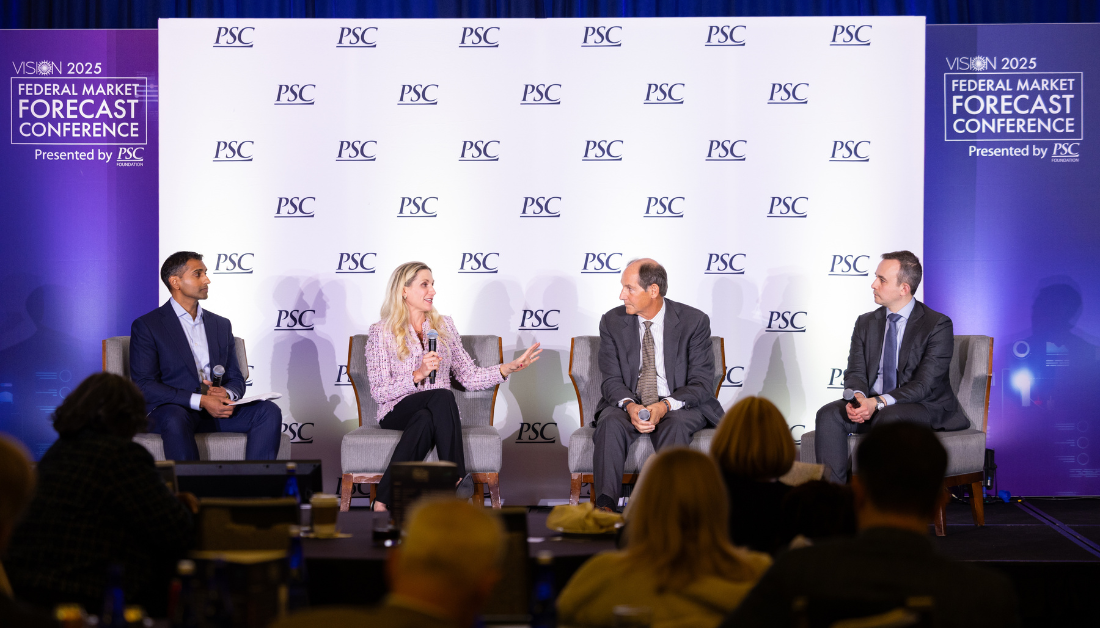
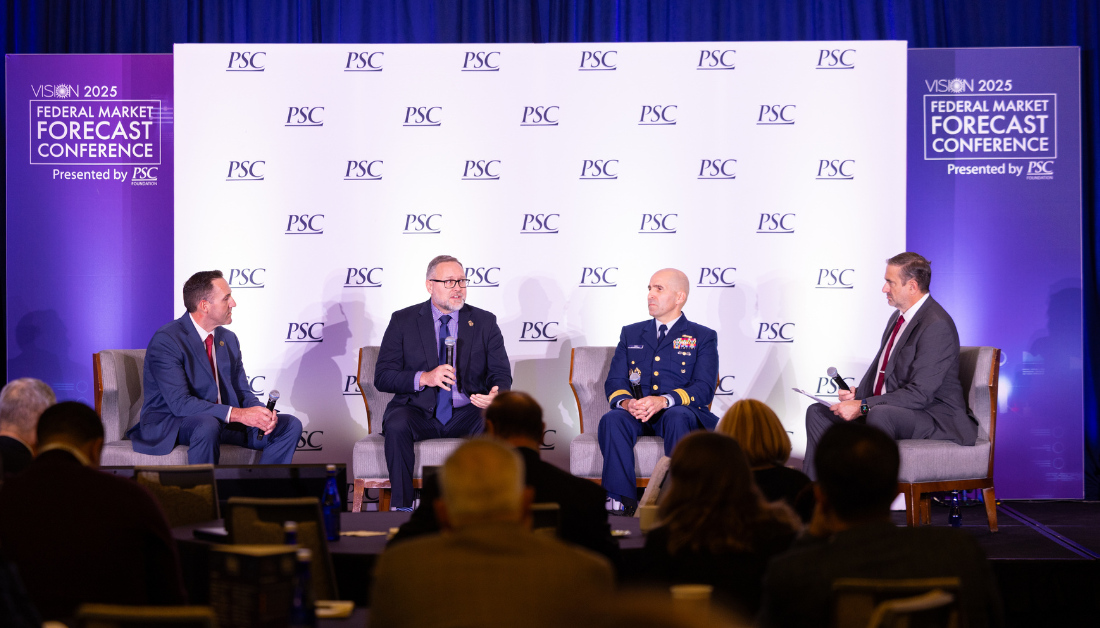
The Ongoing and New Operations at DHS session, involving U.S. Customs and Border Protection, Homeland Security Investigations, and United States Coast Guard officials emphasized how funding from the One Big Beautiful Bill Act is driving a once-in-a-generation transformation across the Homeland Security enterprise through investments in rapid modernization, expanded personnel, advanced technology deployment, and improved cross-agency collaboration. Panelists discussed how these efforts enhance operational readiness, accelerate mission execution, and prepare agencies to address emerging challenges.
2025 Dept. of Health and Human Services Presentation
The Health and Human Services session recognized a year of unprecedented change across the department. PSC Vision volunteers detailed ongoing reorganizations, workforce reductions, and consolidations of IT, acquisition, and administrative functions—all aimed at improving efficiency, transparency, and mission delivery. Agencies (e.g., Centers for Medicare & Medicaid Services, Food and Drug Administration, National Institutes of Health, Centers for Disease Control and Prevention) are prioritizing data interoperability, AI integration, and analytics while navigating budget pressures. This creates opportunities for industry partners who can provide innovative, compliant, and mission-aligned solutions.
The DoD IT & Cyber session summarized the Department’s focus on AI, zero-trust approaches, and modernized acquisition to maintain a warfighting advantage. PSC Vision volunteers emphasized critical workforce challenges, including staff reductions and hiring freezes, and stressed that industry partnerships are essential to fill gaps, deliver secure and (where appropriate) modular technology, and accelerate mission-ready solutions. In today’s defense landscape, speed, security, and skilled personnel are non-negotiable for operational success.
The Defense Services session articulated that the landscape is shifting rapidly in this specific area. Near-term budget growth focuses on homeland defense, missile defense, cyber, and modernization while legacy programs face pressure and human capital shortages. Industry must remain agile and responsive to policy and program changes that emphasize the use of AI, commercial solutions, and innovative acquisition strategies to meet evolving priorities.





.png)